
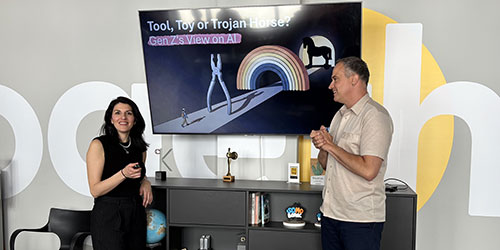
Belgrade, May 12, 2026 – Generation Z in Serbia uses artificial intelligence (AI) almost routinely: more than 80% of young people see it as part of everyday life, and nearly half use AI daily. For them, AI has long gone beyond being just support in school, university, or work. It is increasingly used for creative ideas, organizing daily life, decision-making, and even as support in personal situations.
However, trust does not come without reservations. Only one-third of young people fully trust the information they receive from AI tools, while the rest verify it further. This paradox, AI as part of everyday routine, but not a source of unconditional trust, is revealed in the first regional study on Generation Z’s relationship with artificial intelligence, “Tool, Toy or Trojan Horse? Generation Z’s View of AI,” conducted by McCann Beograd and UM Beograd, members of AMA Group. In addition to Serbia, the study covers six more regional markets and highlights the complex relationship Generation Z has with AI.
“Generation Z uses AI every day, but that does not mean they trust it unconditionally. Young people want to assess for themselves what is relevant and authentic, which is key to understanding a generation that grew up with technology but does not blindly trust it,” said Katarina Pribićević, Regional Chief Strategy Officer within McCann agencies.
When they talk about AI, young people are most often actually referring to ChatGPT. Nearly 90% of respondents use it, while other tools are significantly less represented. Among younger members of Generation Z, ChatGPT is so present that it is often used almost as a synonym for AI.
Although AI has become part of everyday life for this generation, the way they use it is not always the same. Girls more often turn to AI tools when seeking help with communication, advice on health, nutrition, or personal dilemmas, while boys more frequently use them for financial topics. Differences are also evident in the level of trust. Girls are more likely to adjust AI responses to what they already know, while boys tend to accept them more directly.
This caution, however, is not visible only in verifying answers.
Despite using AI regularly, young people do not perceive it as indispensable. Nearly 90% of respondents say they could function without it, suggesting that the first fully digital generation may already be experiencing some level of technology fatigue. Their main concerns are not related to AI, but rather to uncertainty, pressure, and the challenges they face in everyday life. Therefore, the fact that 69% of young people want less technology and more human contact does not indicate a rejection of technology, but rather a need to preserve originality, closeness, and creativity within a digitally saturated daily life.
This is also reflected in their attitude toward authenticity. As many as 58% of Generation Z in Serbia are concerned about the increasingly blurred line between real and AI-generated content, compared to the regional average of 51%. At the same time, 59% of young people say it is becoming harder to distinguish AI-generated content from human-created content, while 63% state that they are bothered when AI-generated content is presented as real without clear disclosure. As technology-assisted content becomes more convincing, it is increasingly important for young people to know what is real and whom they can trust.
“For brands, this is an important signal: Generation Z does not reject AI, but they do not want technology to replace ideas, effort, and the human tone. If communication feels generic or insincere, young people recognize it quickly. AI can be a useful tool, but relationships with this generation are still built through understanding and authenticity,” explained Aleksandar Đorđević, Chief Innovation & Strategy Officer at UM agencies.
The study was conducted in February 2026 through an online survey on a nationally representative sample of young people aged 16 to 28, as well as through focus groups in Belgrade. In Serbia, 500 respondents were surveyed, the same number as in Slovenia, Croatia, Bosnia and Herzegovina, Bulgaria, and Montenegro, while 300 respondents participated in North Macedonia. Through regional data and discussions with young people of different ages, genders, and socio-economic backgrounds, the study provides a broader perspective on how Generation Z today understands, uses, and questions artificial intelligence, as well as why trust has become one of the key issues of the digital environment.
